Pages

Monday, January 21, 2013

Recent Changes in Minimum Credit Criteria by Lending Club

Minimum Credit Criteria

In November, Lending Club not only hide the details of underwriting process, as described in my previous post Lending Club Loans - Impact of Recent Changes, but also changed the minimum credit criteria for the borrowers. The new minimum credit criteria is much more lenient and directed at attracting lower quality borrowers.

The minimum credit criteria in the latest prospectus filed in November 2012 is listed as follows:
Under the current credit policy, prospective borrower members must have among other elements:
  • a minimum FICO score of 660 (as reported by a consumer reporting agency);
  • a debt-to-income ratio (excluding mortgage) below 35%;
  • minimum credit history of 36 months;
  • 6 or less inquiries in the last 6 months; and
  • at least 2 revolving trade accounts.
The minimum credit criteria in the previous prospectus filed in August 2012 is listed as follows:
Under the current credit policy, prospective borrower members must have among other elements:
  • a minimum FICO score of 660 (as reported by a consumer reporting agency);
  • a debt-to-income ratio (excluding mortgage) below 35%;
  • a credit report (as reported by a consumer reporting agency) without any current delinquencies, recent bankruptcy, tax liens or non-medical related collections opened within the last 12 months, and reflecting:
  • at least two accounts currently open;
  • for credit credits 740 and higher, no more than 8 credit inquiries on the credit report in the past six months and for credit scores below 740, no more than 3 inquiries on the credit report in the past six months;
  • a revolving credit balance of less than $150,000;
  • utilization of credit limit not exceeding 98%; and
  • a minimum credit history of 36 months.
The bold text above indicates the new condition added in the minimum credit criteria and the strikeout text above indicates the conditions removed. The new condition is nothing more than the lenient version of number of credit inquiries in the past six months.

Public Records

There was some discussion on LendAcademy forum about Increase in Applicants With Public Records. The table below shows the monthly loan volume with respect to number of public records for loans issued in 2012. In November, 127 loans were issued to borrowers who had at least one public record. The number of such loans increased to 202 in December, an increase of almost 60% over previous month.


I believe the changes in the minimum credit criteria as mentioned in November prospectus may have resulted in increase of borrowers with public records in December. No longer Lending Club excludes borrowers with current delinquencies, recent bankruptcies, tax liens, and non-medical related collections in past 12 months.

Did Lending Club modify 'proprietary' credit grade model to accommodate this change in minimum credit criteria? I was expecting the credit grade shifting to the right toward grade G for such loans. The table below shows the monthly volume and credit grade of loans issued to borrowers with more than 2 public records. There is no shift in credit grade of loans to borrowers with public records. It doesn't appear that Lending Club credit grade model accounts for the number and type of public records.


Accounts Now Delinquent

The table below shows the monthly loan volume  with respect to borrowers' number of accounts currently delinquent. It is clear from the table that prior to December, Lending Club didn't issue any loans to borrowers who had delinquent accounts at the time of applying for loan. In December 2012, Lending Club issued 15 loans to borrowers who had one or two accounts delinquent at the time of loan application.


The credit grade for loans to borrowers with one account delinquent ranged from A5 to F1 while the one loan to borrower with two accounts delinquent has credit grade of F3. It is too early to determine whether Lending Club's proprietary credit grade model accounts for borrowers who have accounts delinquent currently.

Amount Delinquent

The table below shows the monthly loan volume with respect to total amount currently delinquent for borrowers. Similar to accounts now delinquent above, in December 2012, Lending Club started issuing loans to borrowers who have any amount delinquent currently. In December 2012, Lending Club issued 10 loans to borrowers who had between $25 and $65,000 amount delinquent.


Did Lending Club proprietary credit grade model account for borrowers who have any amount delinquent currently? Not a chance! Any reasonable proprietary model most likely will consider borrower with higher delinquent amount to be of higher credit risk.

See the table below that shows the credit grade of loans issued in December 2012 to borrowers who had any delinquent amount. First, there is no visible pattern between credit grade and delinquent amount. Second, which reasonable model that accounts for currently delinquent amount will assign credit grade A5 to a loan for a borrower who has $65,000 in delinquent amount versus grade F1 to a loan for a borrower who has $25 in delinquent amount? This leads me to believe that the credit grade model doesn't account for amount currently delinquent.


Key Takeaways

  • Lending Club has relaxed the minimum credit criteria to attract more borrowers that most likely will result in more borrowers with higher credit risk on lending club platform.
  • Lending Club proprietary credit grade model doesn't appear to account for the credit quality of the new borrowers that only became eligible since lowering of minimum credit criteria.
  • Lenders may benefit by taking the 'common sense' approach to details of public record, and accounts and amount currently delinquent until sufficient historical data is captured to show the pattern and impact of such borrower attributes.

How can PeerCube help?

The loan details page on PeerCube can be of great help to lenders as it shows 71 different loan and borrower attributes including the above-mentioned attributes that may shed better light on borrower's credit quality.

Below is a screen capture of PeerCube's loan detail page for a C2 credit grade loan with such attributes highlighted. Will you invest in a C2 grade loan whose borrower has one bankruptcy, two tax liens, two delinquent accountss and $5,369 amount currently delinquent?


Reviewing the loan detail page, PeerCube users can avoid loans that may be of higher risk than the assigned credit grade represents.

Around the Web

In last few weeks, I have become a big fan of blog Long-Term Returns. I highly recommend the blog to all readers interested in personal finance and investment. Most personal finance bloggers tend to express opinions based on personal experiences and without supporting data. That is where this blogger sets himself apart with the analytical perspective. Though the blogger is not a fan of peer to peer lending, p2p lenders will also benefit from his coverage of related topics of bonds, treasuries and fixed income securities.

Monday, January 14, 2013

Lending Club Loans - Impact of Recent Changes

Recently, in response to my post Lending Club 2012 in Review, Part I: Loan Volume and Amount Funded, a commentator pointed out a few recent changes related to Credit Grade in Lending Club's November 2012 prospectus and scarcity of F credit grade loans. Also, on LendAcademy forums, there were a few related discussions: High demand for D-G grades, Increase in Applicants With Public Record?, and Has LC loan quality dropped?. So, I decided to review the prospectus to see if I can find these changes.

Below is a highlight from the November 2012 prospectus available at Lending Club website:
Q: What are LendingClub loan grades?

A: For borrower members who qualify, we assign one of 35 loan grades, from A1 through G5, to each loan request, based on the borrower member’s:
  • FICO score; 
  • our proprietary scoring model which takes into account many of the attributes previously used by us and also allows borrowers to have delinquencies and public records
  • loan term and loan amount
In addition to replacing previously listed loan and borrower attributes with the proprietary scoring model, the current prospectus also mentions allowing borrowers with delinquencies and public records. Both terms are highlighted above in bold.

The fewer low quality D-G grade loans may be result of the proprietary scoring model modifying weight of previously used loan and borrower attributes or incorporation of new 'unknown' attributes. Allowing borrowers with delinquencies and public records may be resulting in increase in borrowers with public record.

Such changes are not surprising as Lending Club is gearing up for IPO. It's focus has been shifting to non-lending financial institutions as lenders and attracting more borrowers to its platform becoming higher priority.

Can we confirm these changes using historical data from 2012?

Credit Grade Distribution of Monthly Loan Volume

The chart below shows the monthly loan volume in 2012 in relation to Credit Grade. The monthly volume lines for most months follow the same pattern except for December (Green line). There is a shift in the line for December from regular pattern for other months indicating there may have been a change in December how loans were allocated to different Credit Grade buckets.

Lending Club Monthly Loan Volume and Credit Grade in 2012
For most businesses, December tend to be a unique month due to holidays and end of calendar year. The chart below shows the monthly loan volume for 2011. The hypothesis being that if December is somehow unique month for share of loan volume across Credit Grade, it should show up in previous years too. As the chart shows, there is no deviation in line for December compared to the pattern for other months in 2011. This confirms that something changed in how credit grades are assigned for loans issued in December 2012.

Lending Club Monthly Loan Volume and Credit Grade in 2011

Monthly Loan Volume Change

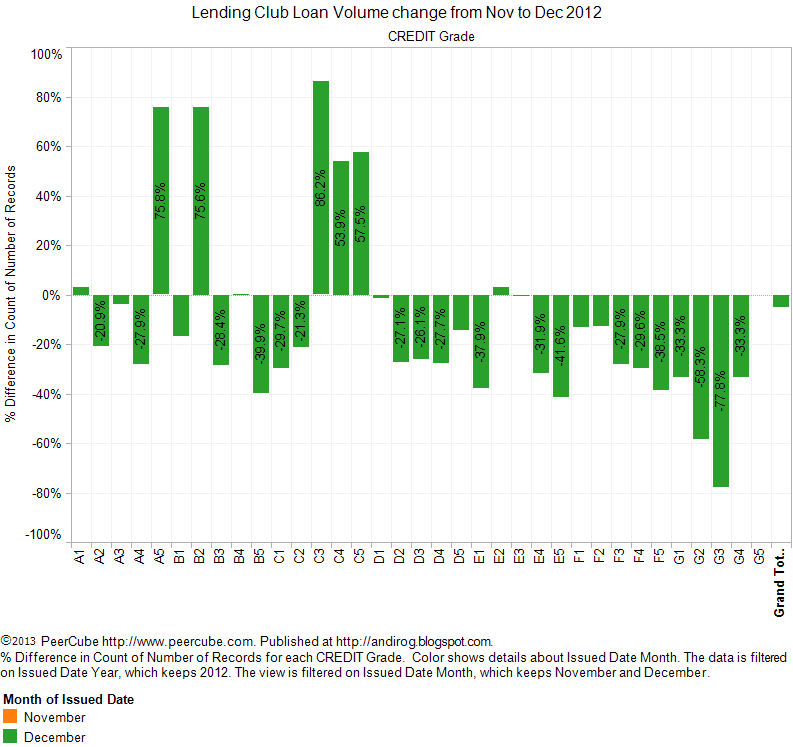
The chart below shows the percentage change in loan volume for each credit grade in December from previous month in 2012. The large spreads in percentage change for credit grades that normally has low loan volume is understandable. The interesting observation is that the percentage volume change for credit grade D through G is consistently negative in the month of December, indicating the loan volume for credit D through G was much smaller in December than previous month.

Lending Club Loans - Percentage Monthly Volume Change in December 2012
As a comparison, the chart below shows the percentage change in loan volume in November from previous month in 2012. The loans with credit grade D through G show large percentage increase in volume from previous month. Was the volume drop in December for loans with credit grade D through G due to increase in volume of same grade loans in previous month? At this point, it is difficult to separate the influence of policy changes from the up volume in previous month.

Percentage Monthly Loan Volume Change in Nov 2012
Another interesting observation is the large spreads in loan volume for loans with A through C credit grades in December. As shown in the chart for November, most volume changes for such loans will be typically low due to the high volume of loans. An usually large spread in volume will indicate influence of a policy change where shifting of loans taking place across credit grades from credit grade with decline in volume to credit grades with rise in volume.

Key Takeaways

  • The "proprietary scoring model" appears to have made some adjustments that is shifting the loans across credit grade, most probably toward B and C credit grades.
  • Without knowing the actual changes taking place in credit grade assessment of a loan, the credit grade will become an unreliable indicator of quality of loans. In my estimate, just considering Credit Grade as loan selection criteria was accounting for the quarter of the default risk.
  • With the credit grade becoming "proprietary" measure, most lenders may benefit by using Interest Rate bins (buckets) instead. Any analysis of historical data based on credit grade will become less valuable due to uncertain changes in credit grade over time.

PeerCube: Benefits of Loan Details on One Page

In my last blog post Lending Club 2012 in Review. Part III: Loan Title, Loan Description and State of Residence, I mentioned that I may take a short break to discuss a few development at PeerCube. In response, I received a suggestion to maintain the continuity of historical data analysis and discuss any PeerCube updates in a small separate section of the blog post. I thought the idea was excellent and time to time I plan to include PeerCube updates at the end of regular blog posts.

The loan details page on PeerCube includes 71 different loan and borrower attributes on one page. This collection of information enables users to  quickly scan loan details to identify any unusual attributes. With the recent changes in Lending Club policies, it is becoming much more important to review the loan details.

PeerCube Loan Details page: Borrower Details
The above screen capture of Loan Details page for a loan shows an example of discrepency that can be caught by reviewing this page. The Home Ownership is self-reported by the borrower. In this case, borrower reports Renting. Total Mortgage Accounts is reported by the borrower's credit report. In this case, credit report mentions borrower has three mortgage accounts.

Depending on your risk profile, you may decide to skip lending to this borrower due to financial uncertainty of the borrower. For example, this borrower may be a divorcee on hook for mortgage payments on a house occupied by ex-spouse, alimony, child support, etc. Such uncertainty about borrower's financial situation raises the risk profile of this loan significantly. Unless a lender was reviewing multiple spreadsheets made available by Lending Club or easy-to-scan one pager for the loan on PeerCube, he or she will misjudge the default risk with this loan.

Cash back rewards on online gift cards

Thursday, January 10, 2013

Lending Club 2012 in Review. Part III: Loan Title, Loan Description and State of Residence

Continuing the year-end review of Lending Club loans issued in 2012 from Part I and Part II where I discussed Loan Volume, Amount Funded, Interest Rate, Credit Grade and Loan Purpose ...

Loan Title

In 2012, the number of loans issued in relation to number of characters in Loan Title continue to follow similar pattern as previous years. Almost 25% of loans issued in 2012 had exactly 18 characters in loan title. Almost 50% of loans issued had less than 17 characters and 90% had less than 24 characters.

Length of Lending Club Loan Title, Loan Volume, and Total Amount Funded

The most popular 18 characters loan titles in 2012 are listed below. Considering 77% of all loans in 2012 were issued for debt consolidation and credit card refinancing purposes, it is not surprising to see related phrases dominating the loan titles.
  • Debt Consolidation
  • Credit Card Payoff
  • Consolidation Loan
  • 2012 Consolidation / Consolidation 2012
  • 2012 Personal Loan
  • Bill Consolidation
  • Card Consolidation

Loan Description

In 2012, 38% loans issued had no loan description. 50% loans issued had loan description with less than 90 characters. 90% of loans issued had loan description with less than 332 characters.

Length of Loan Description, Loan Volume, and Total Amount Funded
There was not much surprise with 53 character length of loan description, majority of them mentioned debt consolidation or similar variation and a few words. Similarly, 335 character length of loan description was primarily borrowers who wrote a complete sentence.

State of Residence

In 2012, borrowers from 45 different states took out loans on Lending Club platform. Only borrowers from state of Iowa (IA), Idaho (ID), Maine (ME), Mississippi (MS), Nebraska (NE), North Dakota (ND), and Tennessee (TN) were absent. Borrowers from Indiana (IN) joined in 2012. Iowa (IA) dropped off in 2011 and Mississippi (MS) dropped off in 2012.

The average amount per loan continue to rise for borrowers from all states with most increase from 2011 was for borrowers from state of New Mexico (NM), Vermont (VT), and Delaware (DE). The borrowers from Alaska (AK), Massachusetts (MA), and New Mexico (NM) borrowed the highest average amount per loan.

Borrower's State of Residence and Average Amount Funded
Borrower's State of Residence and Rise in Average Amount Funded
One change in 2012 from 2011 was that Texas bumped Florida to be in third place for the highest number of loans issued and total amount funded. California and New York continue to maintain first two spots. There were no significant changes in share of loans issued and amount funded to borrowers in each state in 2012 from 2011.

Borrower's State of Residence, Loan Volume, and Total Amount Funded

In future blog posts, I may take a short break from reviewing characteristics of Lending Club loans in 2012 to discuss a few developments at PeerCube.

Web Hosting - $6.95/mo!